

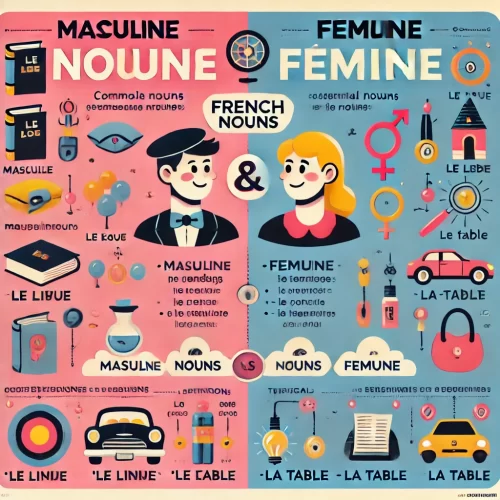
One of the unique features of the French language is that every noun is assigned a gender, either masculine or feminine. Understanding and mastering French nouns and their gender is crucial for language learners, as it influences other aspects of grammar, such as articles, adjectives, and pronouns. In this article, we will explore how French noun gender works, common patterns to identify masculine and feminine nouns, and tips for making gender learning easier.
Why Does French Have Noun Genders?
The concept of gender in French dates back to Latin, from which the French language evolved. Like many Romance languages, French inherited the system of gendered nouns. Although it may not seem intuitive to non-native speakers, learning the gender of French nouns helps you form grammatically correct sentences. In French, articles, adjectives, and pronouns must agree with the noun’s gender. This agreement affects not only the noun but also the words that describe or relate to it.
For example, in English, you would say “a book” or “the book” without changing the article, but in French, it would be:
- Le livre (The book – masculine)
- La table (The table – feminine)
Understanding the gender of nouns is essential to use the language correctly, and with time and practice, it will become second nature.
Identifying Masculine and Feminine Nouns
Although there are exceptions, certain patterns can help you identify whether a noun is masculine or feminine. Let’s break down some of the most common indicators for each gender.
Masculine Nouns
In general, nouns ending in the following suffixes are often masculine:
- -eau: le château (the castle), le manteau (the coat)
- -ment: le moment (the moment), le gouvernement (the government)
- -isme: le tourisme (tourism), le journalisme (journalism)
- -age: le courage (courage), le message (the message)
- -oir: le miroir (the mirror), le tiroir (the drawer)
- -er: le boulanger (the baker), le fermier (the farmer)
Masculine nouns also include many words borrowed from other languages, especially English:
- le parking (parking lot)
- le weekend (weekend)
- le football (soccer/football)
Feminine Nouns
Nouns ending with these suffixes are generally feminine:
- -tion: la situation (the situation), la nation (the nation)
- -sion: la décision (the decision), la télévision (the television)
- -ée: la journée (the day), la pâtée (the food)
- -ure: la nature (nature), la voiture (the car)
- -té: la liberté (freedom), la société (the society)
- -euse: la vendeuse (the saleswoman), la danseuse (the dancer)
Feminine nouns also include the names of most fruits, such as:
- la pomme (apple)
- la banane (banana)
- la poire (pear)
Exceptions to the Rule
While these suffix-based patterns can be helpful, there are many exceptions. For example:
- Le lycée (high school) and le musée (museum) are masculine despite ending in -ée.
- La main (hand) is feminine, despite not following common feminine endings.
Additionally, some nouns are the same in both masculine and feminine forms, particularly professions and roles:
- Le professeur (the teacher) can refer to both male and female teachers, though some professions have gender-specific words (e.g., un acteur vs. une actrice for actor/actress).
Using Articles with French Nouns
In French, articles change depending on the noun’s gender. Here are the primary articles you’ll encounter:
- Le (the) – masculine singular
- La (the) – feminine singular
- L’ (the) – used before singular nouns starting with a vowel or silent ‘h’ (both masculine and feminine), e.g., l’homme (the man) or l’amie (the friend)
- Les (the) – plural (both masculine and feminine)
- Un (a/an) – masculine singular
- Une (a/an) – feminine singular
- Des (some) – plural (both masculine and feminine)
To form grammatically correct sentences, you must ensure that the article matches the gender of the noun. For instance, you say:
- Le livre (The book – masculine)
- La table (The table – feminine)
- L’arbre (The tree – starts with a vowel)
- Les livres (The books – plural)
Agreement with Adjectives
In French, adjectives also need to agree with the gender of the noun they describe. For masculine nouns, the adjective takes the default form:
- Le livre intéressant (The interesting book)
For feminine nouns, most adjectives add an “e” at the end:
- La table intéressante (The interesting table)
In the plural, the adjective takes an additional “s”:
- Les livres intéressants (The interesting books)
- Les tables intéressantes (The interesting tables)
Practical Tips for Learning French Noun Gender
- Learn nouns with their articles: When learning new vocabulary, always memorize the noun along with its article (e.g., le chat, la maison). This will help reinforce the gender from the beginning.
- Use visual aids: Flashcards, charts, or apps can help reinforce noun genders. Try color-coding masculine and feminine nouns in your notes (e.g., blue for masculine and pink for feminine).
- Practice through repetition: The more you expose yourself to French, whether through reading, listening, or writing, the easier it will become to remember noun genders.
- Look for patterns: Over time, you’ll notice common endings and patterns in noun genders, which will make it easier to guess the gender of unfamiliar words.
Conclusion
Understanding French nouns and their gender is a foundational skill for mastering the language. While there are patterns that can help you identify whether a noun is masculine or feminine, exceptions are common, and the best approach is consistent practice. Over time, your intuition will improve, and recognizing noun gender will become second nature. Keep practicing, and don’t be discouraged by mistakes—learning a language is a gradual process!